





How to Accept Crypto Payments on Telegram (2026)
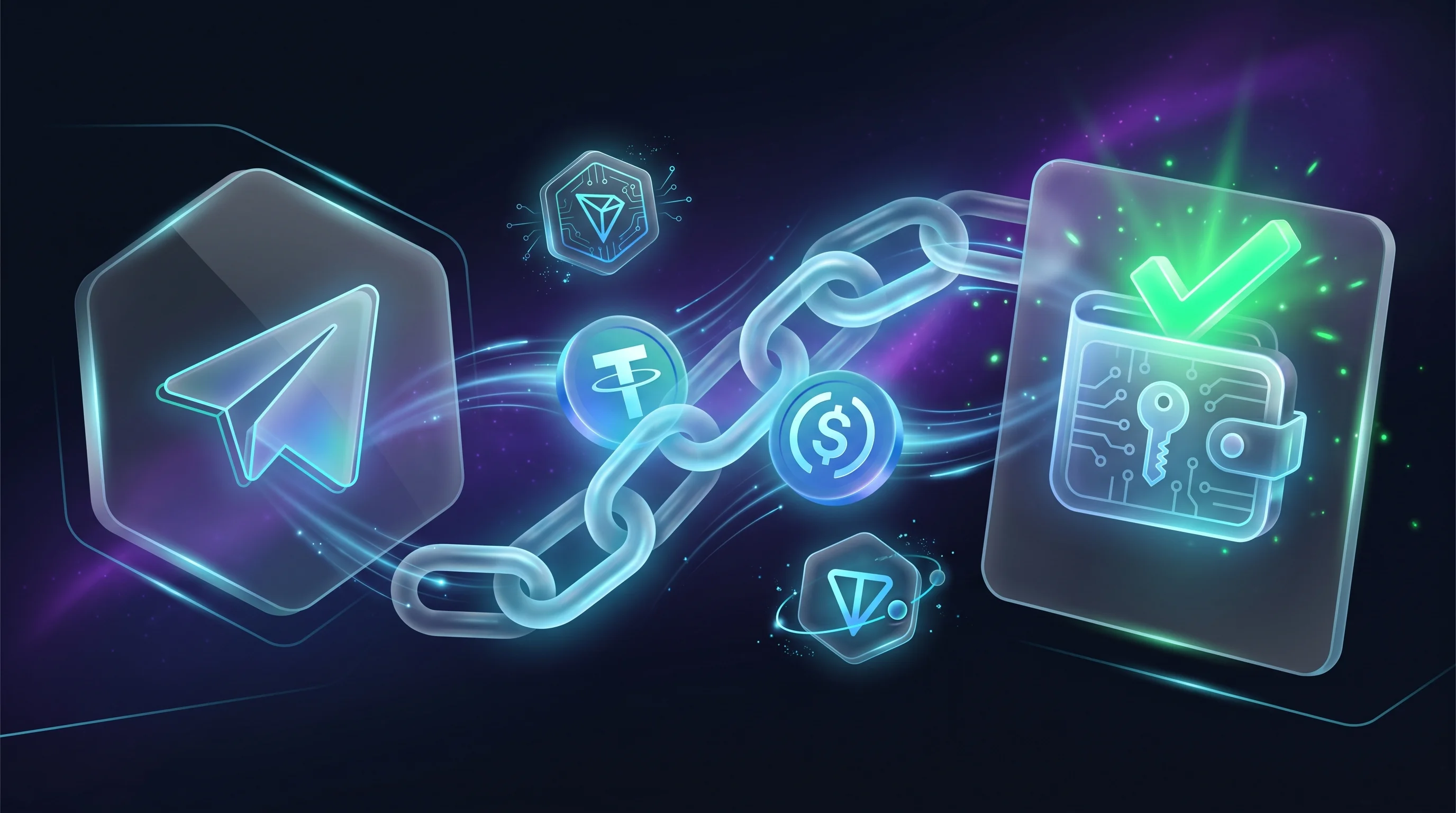
Accepting crypto payments around a Telegram business starts with checking whether the sales context permits crypto. Digital goods and services sold inside Telegram bots or Mini Apps must use Stars, including paid digital access. A buyer already holding USDT does not create an exception. Telegram’s digital-payment rules are explicit about this.
I built GramBase. This guide explains its supported wallet-payment infrastructure and how to investigate transfer problems; it does not recommend stablecoins as a workaround for an in-app digital purchase. For that purchase, follow accepting Stars without coding. For payment architecture decisions, start with the Telegram payments guide.
What a crypto payment setup needs
A supported wallet-payment flow needs a receiving address, an order identifying the buyer and expected payment, and a verification process. Money reaching an address, an order becoming paid and a buyer receiving delivery are separate events.
In GramBase’s stablecoin flow, the buyer transfers funds to your configured address. GramBase does not hold the funds or your private key. It checks the network and transfer before running delivery. That reduces custody by the payment tool; it does not remove wallet, network, issuer or operational risk. See who controls funds in Telegram payments.
Choose a network your buyers can actually use
Choose the asset and network together. USDT on TRON is a different transfer route from USDT on Ethereum or TON. A familiar token name is not enough to identify the correct destination.
| Decision | What to check before accepting payment |
|---|---|
| Buyer readiness | The buyer already has the correct token on the exact supported network |
| Transfer cost | The current wallet or exchange quote, including withdrawal charges |
| Receiving address | You control it, and it supports that network and token |
| Confirmation | Your payment system’s required confirmations, not just a wallet’s “sent” message |
| Support | An order ID and transaction hash let you investigate a delayed or mismatched transfer |
TRON fees are not a fixed $0.20-0.50. Contract transfers use Energy and Bandwidth; insufficient resources can burn TRX at current rates. TRON’s resource model explains those conditions. Ethereum, TON and other networks also need their own current quotes. Do not publish a universal cheapest chain or a guaranteed three-second delivery time.
GramBase supports several networks, with different confirmation requirements. Read the current payment documentation for the supported configurations. Add another network only when you can test and support it; listing every option can make the buyer’s choice harder.
Set up the receiving wallet and payment profile
Use a business receiving address whose transactions you can reconcile. A separate wallet simplifies bookkeeping, but shared seed phrases, compromised devices and reused credentials can defeat the intended security separation.
Keep private keys and recovery phrases out of payment tools, support chats and screenshots. A tool that only verifies incoming transfers needs the public receiving address, not your recovery phrase. Follow the wallet provider’s official backup instructions and protect the account that owns your Telegram bot with two-step verification.
In GramBase:
- Open Finance → Payment profiles and create a profile.
- Add the chain, token and receiving address for each supported method you intend to use.
- Attach the profile from the product’s Pricing & Payment step, only for a permitted sales context.
- Check the address on the buyer-facing order. Updating a profile does not replace the address already saved on a pending order.
This describes the configuration capability. GramBase’s product types are digital goods and paid communities; it is not a physical-goods fulfillment system. Do not infer an allowed product category merely because a payment switch exists. The payment-bot use case describes the infrastructure; the platform rules still determine where it applies.
Test payment and delivery separately
Use a controlled test with an amount you are prepared to spend, after checking the rules for the offer. Record the order ID, network, asset, expected amount, receiving address and transaction hash.
Check that the transfer succeeded on the correct network, reached the expected recipient and met the confirmation requirement. Then inspect the order’s payment state and its separate delivery state. A screenshot from the buyer is a starting point for investigation, not proof of settlement.
Do not require “under 30 seconds” as the pass condition. A healthy flow can still wait for confirmations or queued delivery. Success means the correct order is paid once and the correct buyer receives the configured item or access. Orders and delivery recovery explain what to inspect.
Handle wrong amounts, wrong networks and delayed payments
The buyer sent less than requested
An exchange withdrawal charge, a mistaken amount or a transfer service can leave a shortfall. Native network fees and deducted withdrawal fees are not the same thing.
GramBase sends amount mismatches to review; do not assume a universal 2-3% tolerance silently grants access. Compare the expected amount with the actual transfer and decide whether to refund, accept the shortfall or request a top-up under your policy. Keep the original transfer linked to its order so it is not counted twice.
The buyer used the wrong network
Collect the transaction hash, network, asset contract, destination address and wallet/service type. Recovery depends on whether the destination is valid on that network and who controls it. An exchange deposit and a self-custody address have different recovery paths; TRON and Ethereum addresses are not interchangeable just because the token is called USDT.
Do not import a recovery phrase into an unfamiliar app or give it to support. Follow the receiving wallet or exchange’s official support process. Some mistaken transfers cannot be recovered.
The transfer succeeded but the order is pending
Check network, token, recipient, amount, timestamp and confirmations before changing the order. GramBase offers a transaction-linking path with checks, and a separate Force confirm payment path that performs no network verification. The latter records your evidence but trusts your decision. Read manual confirmation’s prerequisites and limits before using it. It is not available for Stars orders.
The buyer needs a refund
An irreversible transfer does not remove your refund, support or consumer obligations. Explain your policy before checkout. Independently verify the original order and refund destination, including network and asset, and record the separate refund transfer. Do not advertise “no refund risk” as a property of crypto.
Buyers without a wallet
Do not make a digital buyer learn crypto to purchase inside your Telegram bot. Use Stars for that in-app sale.
For a different permitted wallet-payment context, consider whether onboarding is appropriate at all. Availability, identity requirements, minimum purchases and fees vary by wallet or exchange. I previously reported that a wallet onboarding guide converted about 30-40% of buyers who initially said “I don’t have crypto”; the other 60% were unwilling to download a new app. That conversion observation does not establish availability or permission for a particular payment route.
Reconciliation and tax records
Keep order ID, buyer identifier, token amount, actual receipt time, network, transaction hash, local-currency valuation and refunds together. Transfers into a business wallet can also be owner deposits or unrelated receipts, so a wallet balance is not automatically sales revenue.
Stablecoins target a peg; they are not a substitute for valuation records. For example, the US IRS digital-asset guidance treats stablecoins as digital assets and requires relevant records. This is a US example, not a global tax rule. Use your jurisdiction’s requirements and qualified advice when deciding how to report receipts.
Frequently asked questions
Can you receive crypto around a Telegram business?
Yes, supported wallet flows exist. Digital goods/services sold inside Telegram bots and Mini Apps must use Stars. First identify the sales context; then check the applicable payment rules.
Is direct-to-wallet payment risk-free?
No. It reduces custody by the verification tool. Wrong transfers, compromised keys, network failures, issuer restrictions, disputes and fulfillment problems remain possible.
What is the cheapest network?
There is no permanent universal answer. Compare the buyer’s actual network or withdrawal quote and whether they already hold the correct asset, rather than an old fixed gas figure.
Does a paid order prove delivery?
No. Check the delivery log and state separately. Retry only an eligible failed delivery, rather than taking another payment or manually sending duplicate items.
If your immediate goal is paid digital access in Telegram, start with the Stars setup. If you need to review a supported transfer, open the order in GramBase and use the documented checks above.
Questions? DM @Kai, founder of GramBase.
Related guides
View all
How to Accept Payments on Telegram: Rules and Setup (2026)
I compare Telegram payment options by sales rules, Stars pricing, settlement and delivery, so you can choose a setup your business can support.
 Kai | GramBase •
Telegram Payments: Custodial vs Non-Custodial Explained
Understand wallet custody, connected processors and Telegram Stars. Check who controls funds, how settlement works and what risks sellers still need to manage.
Kai | GramBase • Telegram Stars vs USDT: Rules, Checkout and Settlement
Compare Stars and USDT by Telegram payment rules, buyer experience and settlement. Use Stars for digital goods sold inside Telegram bots and Mini Apps.
Kai | GramBase • Start Selling on Telegram Today
One link to sell products and memberships. Checkout and delivery stay inside Telegram.
Start Selling