





Why Chat-Native Commerce Converts 5x Better Than Websites
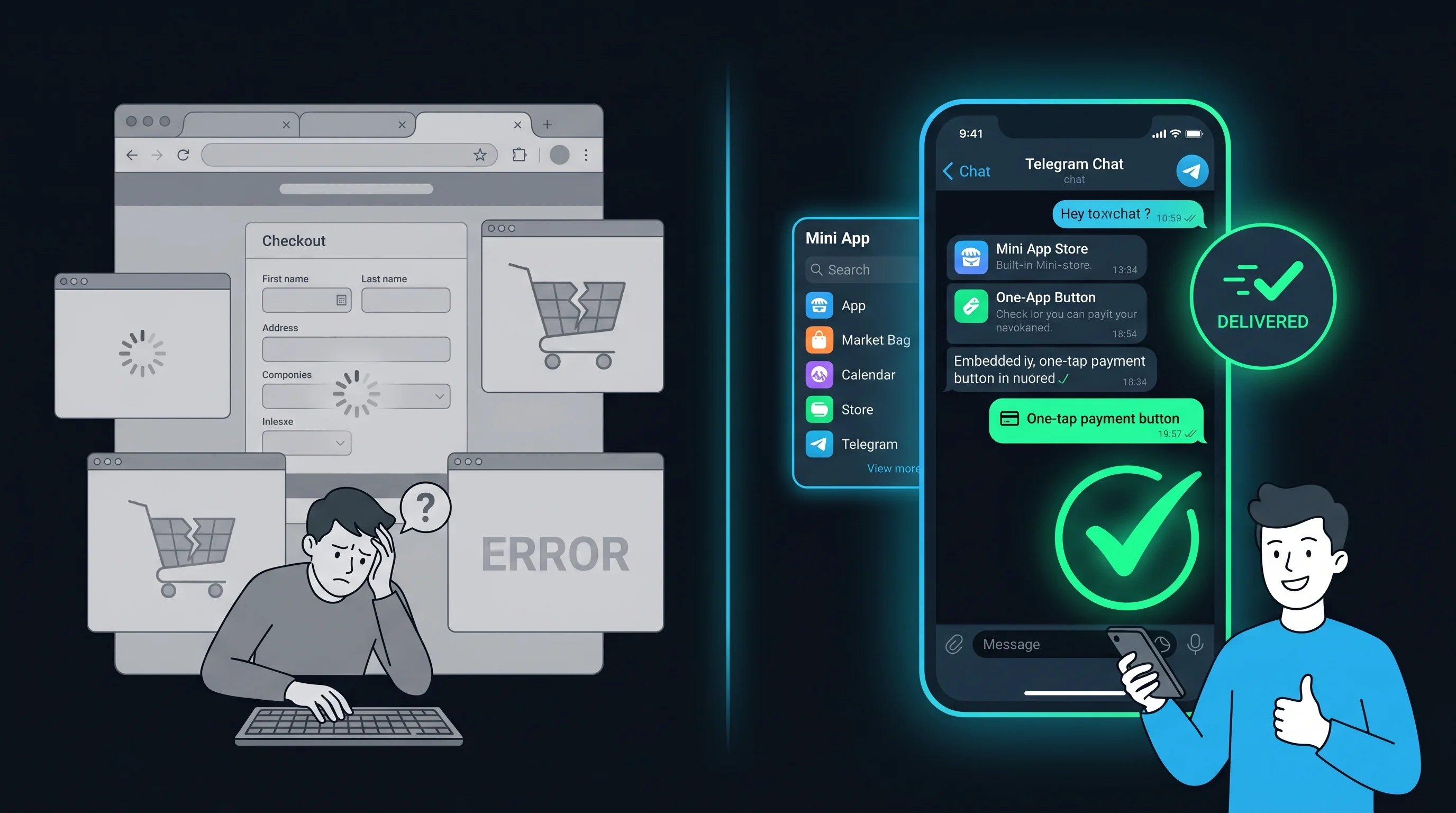
Chat-native commerce keeps product discovery, browsing, payment and delivery close to a conversation. For a creator whose audience already uses Telegram, a Mini App can reduce the need to switch between a channel, a website and an inbox.
I build GramBase. The useful question is which steps your buyer can complete more easily inside Telegram, and which responsibilities still need a separate process. A website can offer fast guest checkout, a course library or shipping tools; moving an offer into chat should solve a specific problem.
Round 1: Friction and flow
An external checkout can lose someone when it opens slowly, presents a different offer or asks for details the buyer is not ready to provide. Account creation is not mandatory on every commerce platform, and card entry is not required for every repeat purchase. Compare the actual buyer journey rather than a deliberately difficult website.
A Telegram Mini App opens inside the messaging app. Telegram identity can reduce separate account setup, and Stars can let a buyer pay for an in-app digital offer without preparing a crypto wallet. A Stars purchase can still require a balance top-up or another payment step.
The previously reported conversion change from 2% to 10%+, reflected in this article’s 5x title, is a conversion observation rather than a guarantee for every offer. The broader figures reported in the Mini Apps guide are 1-2% for an external-link path and 4-7% for a Mini App path. Differences in traffic, price, audience familiarity and checkout design affect the result.
Measure discovery-to-purchase, checkout-start-to-paid and paid-to-delivered separately. A new interface is useful only if more suitable buyers complete a purchase and receive the promised item.
Round 2: Cost and control
Separate the tool, payment processor and platform managing earnings. Gumroad’s public direct-sales pricing is 10% plus $0.50; its Discover marketplace is 30%. Patreon’s current public standard plan is 10% plus applicable processing and other charges, while existing accounts may have different terms. These platforms also provide capabilities a creator may value. Check Gumroad pricing and Patreon pricing before comparing.
GramBase consumes Usage Credits for order processing: 2.5% of an internal USD valuation, minimum five and maximum 2,000 credits per order. With 100 credits valued at $1, that means $0.05-$20 per order. Additional actions can use credits; the cap is not a monthly spending cap. See current pricing.
Paid GramBase membership plans are optional; see current pricing for their monthly charges, included credits and feature access.
In-app digital goods and services must use Stars, under Telegram’s rules. Their earnings are managed through Telegram’s rewards process. GramBase’s direct-to-wallet claim applies to its supported stablecoin flow in permitted contexts, not to every product or Stars purchase. Use the Stars calculator to distinguish buyer price, gross seller reward and tool cost.
Ownership also has several parts. You can control your bot, groups, offer and records while still depending on Telegram reachability and rules. A Telegram membership is not automatically an email contact or consent to message someone elsewhere. See customer relationships and practical ownership.
Round 3: Conversation and support
A conversation can answer a buying question where the customer already spends time. Publish a clear offer, show relevant examples and tell the buyer how to reach support. Speed helps only when the answer is accurate.
GramBase’s Support Inbox brings reachable customer conversations into an operational workflow. It does not mean every community member can be privately contacted, every question gets an instant answer, or a bot removes buyer remorse. Set service hours and escalation rules appropriate to your business.
Compare the flow you can actually deliver
| Decision | Website flow | Telegram Mini App flow |
|---|---|---|
| Conversion observations retained here | 1-2% | 4-7%; some reported moves from 2% to 10%+ |
| Identity | Guest checkout or a platform account, depending on the store | Telegram identity; custom apps must validate it |
| Payment | Supported processor and saved-payment options | Stars for digital goods/services sold in-app |
| Delivery | Download, email, account access or other configured method | GramBase Message, Folder or Inventory; paid-community invitations |
| Support | Contact form, chat or email | Reachable bot conversations and configured support |
| Risk | Refund, processor, account and fulfillment dependencies | Refund, Telegram, bot-permission and delivery dependencies |
The number of taps depends on the buyer’s current balance, authentication and offer. Do not use “two taps” or “instant” as an acceptance rule for every purchase.
Three practical commerce scenarios
1. Paid community access
A buyer selects a period, pays a Stars invoice and receives an invitation after confirmation. The bot needs the necessary group or channel permissions. Explain onboarding and renewal before checkout.
GramBase currently uses a new purchase for manual renewal, despite Telegram supporting a native recurring API. Expiry work is periodic and best effort; it can fail if permissions are revoked. See paid-channel setup and access removal at expiry.
2. A one-time digital product
A Message product can send text or attachments to the buyer’s bot chat. A Folder product can provide access to its contents and updates. Choose the delivery method based on what your offer promises.
Telegram content protection can limit forwarding and saving where supported. It cannot guarantee that a buyer will never take a screenshot or reproduce a document. The digital-goods delivery guide explains supported methods and their limits.
3. A paid media item
Telegram supports paid media in Stars through its native API. This does not establish a GramBase pay-per-view feature: its documented digital delivery methods are Message, Folder and Inventory. Use one of those supported offers or plan a separate integration; do not promise a GramBase crypto button that unblurs a paid video.
Frequently asked questions
What is chat-native commerce?
It is a purchase experience organized inside a messaging app, near product discovery and customer conversation. On Telegram, a Mini App can provide the storefront while a bot handles supported payment and delivery events. The app still needs correct confirmation, access and support logic.
Does it work for physical products?
Telegram provides payment interfaces for physical goods and services, but shipping, returns and inventory logistics still need an implementation. GramBase’s current product types are digital goods and paid communities; do not infer a physical-fulfillment product from its payment infrastructure.
How do I create a Telegram store?
Configure the bot and product, set the Stars price for an in-app digital offer, choose supported delivery and test a confirmed order. Publish the storefront only after checking the buyer can receive it. Follow the shop-bot guide and storefront documentation.
Questions? DM @Kai, founder of GramBase.
Related guides
View all
Telegram Mini Apps 2026: 7 Revenue Models and Limits
I compare seven Telegram Mini App revenue models by product fit, Stars rules, delivery limits and the separate features you may need to build.
 Kai | GramBase •
Telegram Shop Bot: Create a Store Without Coding (2026)
Create a Telegram shop bot with a catalog, Stars checkout and file or paid-access delivery. Test products, storefront links and failed deliveries.
Kai | GramBase • 
Why Creators Are Moving to Telegram in 2026 : And How to Start
Build an owned audience on Telegram with portable content, opt-in contact routes and replaceable tools. Understand reach, payment and platform limits.
Kai | GramBase • Start Selling on Telegram Today
One link to sell products and memberships. Checkout and delivery stay inside Telegram.
Start Selling